|
Nitrogen monoxide, NO is a colorless,
toxic gas. In air it is oxides into nitrogen dioxide NO2.
Nitrogen dioxide is a brown, toxic gas with a pungent odor.
NO and NO2, are named NOx.
These emissions along with sulfur dioxide causes acid rain. Because
of these emissions, many new rules have been adopted in recent years.
Alarm limits for NO2 or NO
for monitoring of the ambient air are set according to the
occupational exposure limits:
-
Alarm 1 = 4 ppm 30 ppm, threshold lvl.
-
Alarm 2 = 5ppm 50ppm, Max exp. lvl.
If the source is exhausts set the following
limits:
-
Alarm 1 = 1ppm 20ppm, threshold lvl.
-
Alarm 2 = 5ppm 25ppm, Max exp. lvl.
Alarms are preferably set according to these exposure levels with
the threshold limit value as the first alarm limit and the top limit
value as the second other alarm limit.
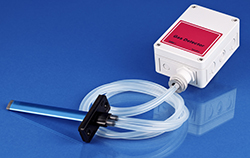
Using aspiratory systems can be probematic since the NO2
is easily absorbed by the material in gas pipelines.
Detector location
Both nitrogen monoxide and nitrogen dioxide are heavier than
air, which theoretically means that the gas will fall to the floor
in air, but these gases are also sensitive to drafts, etc.
Fire Hazard
Both NO and NO2 are
combustible gases.
Nitrogen oxides NOx
These oxides cause acid rain, which gives both acidified lakes and
algal blooms in eutrophic waters.
High concentrations may cause respiratory
diseases.
Gas monitoring and demand controlled
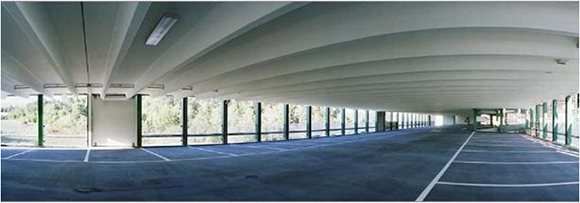
ventilation in garages and parking garages
Nitrogen dioxide NO2 is
formed in bus- and truck garages, road tunnels, mountain cavities,
etc.
Gas monitoring in garages meet two main
needs:
-
To warn when the quantity of harmful gases
reaches an unhealthy level.
-
To ensure that the management of
ventilation is done the best and most profitable way, ie.
according to fresh air requirements.
When the concentration becomes too high, the
fans starts automatically and stops again when the NO2 concentration
has down to the predetermined level.
Harmful gases
Harmful amounts of nitrogen oxides (NOx), hydrocarbons (HC) and
carbon monoxide (CO) can be obtained from petrol and diesel exhaust
fumes. As a rule only carbon monoxide is
monitored in the garage since it is often wrongly believed that the
other gases do not reach harmful levels.
Carbon monoxide is an extremely dangerous
toxic gas. Earlier, people often commited
suicide by inhaling exhaust fumes from cars.
Today, the concentrations are much lower,
thanks to catalytic converters in cars and carbon monoxide is no
longer an environmental problem, except perhaps at cold starts.
Regarding carbon monoxide and nitrogen
dioxide from a gas
monitoring point of view, it is appropriate to have two alarm
levels, one of which occurs at 20 ppm (CO / resp 1-2 ppm
(NO2), and the second at about 25 ppm or 5 ppm.
Hygienic threshold limit values for NO2 (gaser from diesel
vehicles, propane driven ice makers).
-
NGV = 1 ppm if source from exhaust fumes:
Warning, fan starts at half or full speed
-
TGV = 5 ppm: Alarm, upper threshold limit
With NGV is
understood a concentration that is acceptable for a full day (8
hours).
TGV is the concentration of the average value
during 15 minutes of carbon monoxide level / nitrogen dioxide level.
The alarm level is exceeded in two gas
sensors simultaneously for the warning lights to be activated.
At the higher alert level, for example, on a
juice blender warns of unhealthy levels of carbon monoxide /
nitrogen dioxide levels, it is advisable to have exceeded the higher
of two gas sensors simultaneously for juice blender to be activated.
The reason is to avoid the "distorting load"
it can give rise to if a car happens to be in direct proximity to a
sensor resulting in of an overdose of carbon monoxide or nitrogen
dioxide.
A sensor density of at least 1 sensor /
400-500m2 is appropriate.
If there is heavy traffic in the garage, it
is important to take account of other harmful gases Nox (collective
term for various nitrogen oxide compounds) and hydrocarbons.
In similar cases specific CO and NO2 sensors
cannot cover the need for detection. Other sensors are required that
can detect these gases.
Ventilation control
The minimum requirement to for ventilation control is that the gas
monitoring facility affects ventilation in such a way that if there
is harmful gas the fresh air intake should increase enough for the
gas concentration to be reduced to harmless levels.
A well-regulated demand controlled
ventilation in a garage not only improves the air quality but also
minimizes energy consumption by avoiding unnecessary ventilation.
If you optimize ventilation according to the
gas concentration it is enough to ventilate when the air is bad.
With a modern gas monitoring plant you can
obtain not only alarm functions (two levels) but also control
functions for air evacuation.
NO2 alarm in ice rinks
In the case of ice rinks where the nitrogen dioxide may occur at the
incomplete combustion of LPG-powered ice-makers and thus cause
health-damaging concentrations, it is recommended that a detector be
placed at either short ends of the rink diagonally from each other
to get the best coverage.
See also Projecting Guide
Choice of Equipment
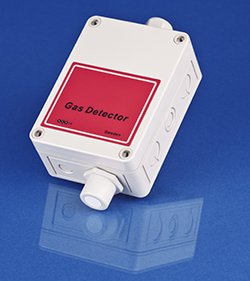
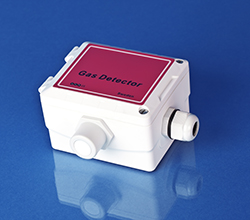
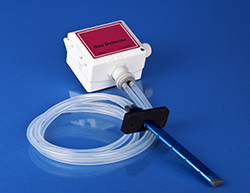
The Stand-alone detector is a detector
where power supply, alarm and control functions are integrated in
the detector housing. This detector is used where very simple
systems are sought and only few monitoring points are desired.
|